The award recognizes the school as an outstanding example of how education, architecture, and sustainability can come together.
The Josef-Schwarz-Schule in Heilbronn received the Deutscher Nachhaltigkeitspreis Architektur 2026 at the Forum Nachhaltige Architektur in Mannheim on October 21. The other finalists included the renovation of naTo e.V. by SUMMACUMFEMMER and the Moabiter Kinderhof in Berlin by Kersten Kopp Architekten.
Three pavilion-like buildings are arranged around an elevated landscape plateau that provides schoolyards and outdoor spaces. The timber-hybrid construction, thermally activated clay ceilings, and low-tech energy concept reflect the project’s resource-conscious approach. As a bilingual all-day school, the campus also serves as a place for the local community in Heilbronn’s Neckarbogen district. The Haus der Familie, the “Josefs” neighborhood café, and the sports facilities help connect the school with its surroundings.
We see this award as recognition of the collective effort behind the project. Thank you to the client, our project partners, all specialist consultants, and the construction teams. The project reflects our approach to architecture: creating places that respond to the needs of their users while making responsible use of resources and urban space.
In addition, our thanks go to the DNP Architektur, DGNB and the Forum Nachhaltige Architektur team for hosting the award ceremony and bringing together the teams behind the nominated projects.
How can a school become a vibrant part of the city? Josef-Schwarz-Schule offers a compelling answer: public spaces, landscaped outdoor areas and sheltered learning environments come together in an open, light-filled building that encourages both orientation and connection.
On Friday, the project received the Hugo Häring Auszeichnung for the Heilbronn-Franken Region at the award ceremony in the Schießhaus in Heilbronn. The jury describes the school as “a city in itself”, highlighting its welcoming atmosphere and the fluid transitions between indoors and out. The generous overhangs provide shelter from sun and rain while creating a gradual connection between the building and its surroundings. The result is a school that supports learning and gives social life in the new neighbourhood a place to flourish.
We celebrated the evening with many other outstanding offices, several of our specialist consultants (Planstatt Senner, ERNST² ARCHITEKTEN AG, schlaich bergermann partner) and the client Schwarz Immobilienmanagement GmbH & Co KG. This recognition is a testament to the collaborative effort behind the project. It also marks the next step: all projects receiving an award are now in the running for next year’s Hugo Häring Landespeis.
Thank you to BDA Baden-Württemberg for this great evening and thank you to everyone who helped bring this place to life.
How can architecture respond to climate change while creating liveable, inclusive and future-oriented spaces?
On 22 October 2026, Stefan Behnisch, Founding Partner of Behnisch Architekturbüro, will be speaking at the Palazzina Reale in Florence. The event is promoted by the Fondazione Architetti Firenze (Florence Architects Foundation) as part of the “Glance Around. What else?” project and curated by Arianna Callocchia.
Under the title “Spazio pubblico, città e paesaggio – Architettura e sviluppo urbano sostenibile” he will present selected projects in the fields of sustainable architecture and urban development. The projects address some of the key challenges of our time, including the reduction of CO₂ emissions, the responsible use of resources, and the relationship between people, the built environment and nature.
The lecture will be held in English and It will be followed by a panel debate with questions from the audience.
Palazzina Reale, Piazza della Stazione 50, Florence Thursday, 22 October 2026 5:00–7:00 pm Admission is free and the event is open to the public.
More info in Italian available at the following link: https://architettifirenze.it/eventi/talk-stefan-behnisch
Two recent visits to Italy offered the opportunity to explore new materials, exchange with experts, and gather inspiration for current projects.
In Bologna, our partner Stephan Leissle attended Cersaie 2026, the international exhibition for ceramics. The visit offered a broad look at current developments in surfaces, tile solutions, and bathroom furnishings, with valuable inspiration for ongoing projects such as Thermal Spa Bad Aibling. A guided city tour added architectural and urban impressions beyond the exhibition halls.
In Salento, architects and interior architects came together for the Workshop „IM TON – Farbe in Gesundheitsräumen“, hosted by NORA/Interface and organized by Christina Dragoi of LAYER -1. Our colleague Effi Schneider took part in the exchange on how materials and color can support different uses in healthcare spaces while remaining relevant beyond short-term trends. In hands-on group sessions, local materials, and NCS color tones were combined into spatial color and material concepts.
Highlights from the latest I2SL tour at Harvard University: As part of the I2SL (International Institute for Sustainable Laboratories) conference, our partners Christine Napolitano and Erik Hegre joined van Zelm Engineers , Transsolar, and Turner for a tour of Harvard University’s Science & Engineering Complex. The SEC was recognized with the I2SL 2023 Lab Buildings and Projects Award for New Construction. For us, the tour was a special opportunity to revisit a project we realized together with an exceptional team and that continues to set a high standard for sustainable academic architecture, high-performance laboratory design, and occupant well-being. Highlights included the naturally ventilated atrium, the engineered façade, integrated sustainability strategies, and the collaborative learning and research environments that make the SEC such a forward-looking campus building. The project’s sustainability achievements have earned multiple prestigious awards, including LEED Platinum, Living Building Challenge Petal certifications for Materials, Beauty, and Equity, AIA COTE Top Ten, and 2021 SEFA Lab of the Year.
More on the SEC’s sustainability strategies: harvard.edu
LIFE HAMBURG marks the beginning of a new chapter for learning in Hamburg.
The campus brings together lifelong learning, making, culture, wellbeing, physical activity and community in one shared place. Conceived as an open architectural framework, it offers spaces where people of different ages, interests and backgrounds can meet, explore, learn and develop together.
At its core, the Agora forms the spatial and social heart of the campus. It connects flexible learning areas, workshops, research spaces, places for exchange and areas for shared activity, creating a generous setting for encounter, informal learning and everyday campus life.
The Josef-Schwarz-Schule in Heilbronn has been nominated for the German Sustainability Award for Architecture (Deutscher Nachhaltigkeitspreis Architektur).
This nomination recognizes a project that combines high-performance wood-hybrid construction with an open, terraced landscape. Rather than creating standard, isolated structures, the design features a single building composed of three terraced volumes interconnected by an elevated schoolyard plateau that serves as a protected setting for movement, social interaction, and learning. Designed with natural, CO2-storing materials, a low-energy climate concept, and flexible learning studios, the campus exemplifies how structural efficiency and environmental performance can directly shape contemporary educational environments.
We are among 10 selected projects that reflect the DNP’s vision of architectural quality as a natural expression of sustainability. The winner will be announced at the Forum Nachhaltige Architektur this October in Mannheim. We look forward to the announcement. View the nominees here.
Thank you to our partners, and everyone involved in this project.
Partner Michael Innerarity presents the National Unity Center at the Ukraine Recovery Conference 2026.
How can architecture contribute to rebuilding a society? This question was at the heart of the Ukraine Recovery Conference 2026 in Gdańsk, where the Ukrainian Catholic University (UCU) presented the National Unity Center, a project that places education, lifelong learning, and human connection at the centre of Ukraine's long-term recovery. Together with UCU, Behnisch Architekturbüro is proud to contribute to a place designed not simply as a building, but as an investment in people.
The National Unity Center builds on a long-standing collaboration between Behnisch Architekturbüro and the Ukrainian Catholic University. Following the completion of the Metropolitan Sheptytsky Center in 2017, the new project represents the next chapter in a shared commitment to creating places that foster learning, dialogue, and community. Nearly a decade after shaping an important part of the UCU campus, this collaboration continues with a vision for architecture that supports both people and society.
Located adjacent to the existing campus, the National Unity Center has been conceived as a living-learning environment that integrates education, residential life, and collaborative spaces within one coherent architectural framework. The seven-storey building will provide approximately 6,000 square metres of flexible learning environments, co-working spaces, residential units, meeting areas, and public facilities designed to support a wide range of users and activities. At its core, however, the project is not about a building. It is about people. The Center is intended for those who will play an active role in rebuilding Ukraine: veterans and their families, internally displaced people, educators, entrepreneurs, public-sector leaders, students, and international partners. It offers a place where knowledge can be shared, new skills developed, and relationships strengthened across disciplines, generations, and regions.
Its educational vision is built around four interconnected pathways—Upskilling, Reskilling, Re-enter, and Return—establishing the Center as a platform for lifelong learning and institutional renewal. The project reflects the understanding that recovery is not only about physical reconstruction, but about strengthening human capital, leadership, and civic responsibility that will shape Ukraine's future.
During the Ukraine Recovery Conference, UCU presented the project to an international audience of government representatives, businesses, institutions, and civil society organisations. As part of the event, the Ukrainian Catholic University and Behnisch Architekturbüro signed a Memorandum of Cooperation, reaffirming their shared commitment to bringing the project to life. Michael Innerarity presented the architectural vision behind the design, emphasising flexibility, adaptability, and the creation of spaces capable of responding to evolving educational needs for decades to come.
The architectural concept reflects principles that have long guided Behnisch Architekturbüro's work: openness, adaptability, and environmental responsibility. Passive façade shading, integrated photovoltaic panels, and carefully considered daylight strategies reduce energy demand while creating healthy, comfortable learning environments. Sustainability is embedded in the building's performance and in the everyday experience of its users.
The National Unity Center is a place where people will learn, reconnect, exchange ideas, and build trust. A place designed to strengthen the human networks that will shape Ukraine's future.
The Josef-Schwarz-Schule is part of this year’s Heinze ArchitekturAWARD and is currently in the running for the Audience Award.
Bringing together education and sustainability, the project creates a forward-looking campus designed to support contemporary learning. Timber-hybrid construction, regionally sourced materials, geothermal energy, and photovoltaic systems contribute to a healthy and resource-efficient environment. At the same time, the architecture fosters collaboration, community, and a diverse range of learning experiences.
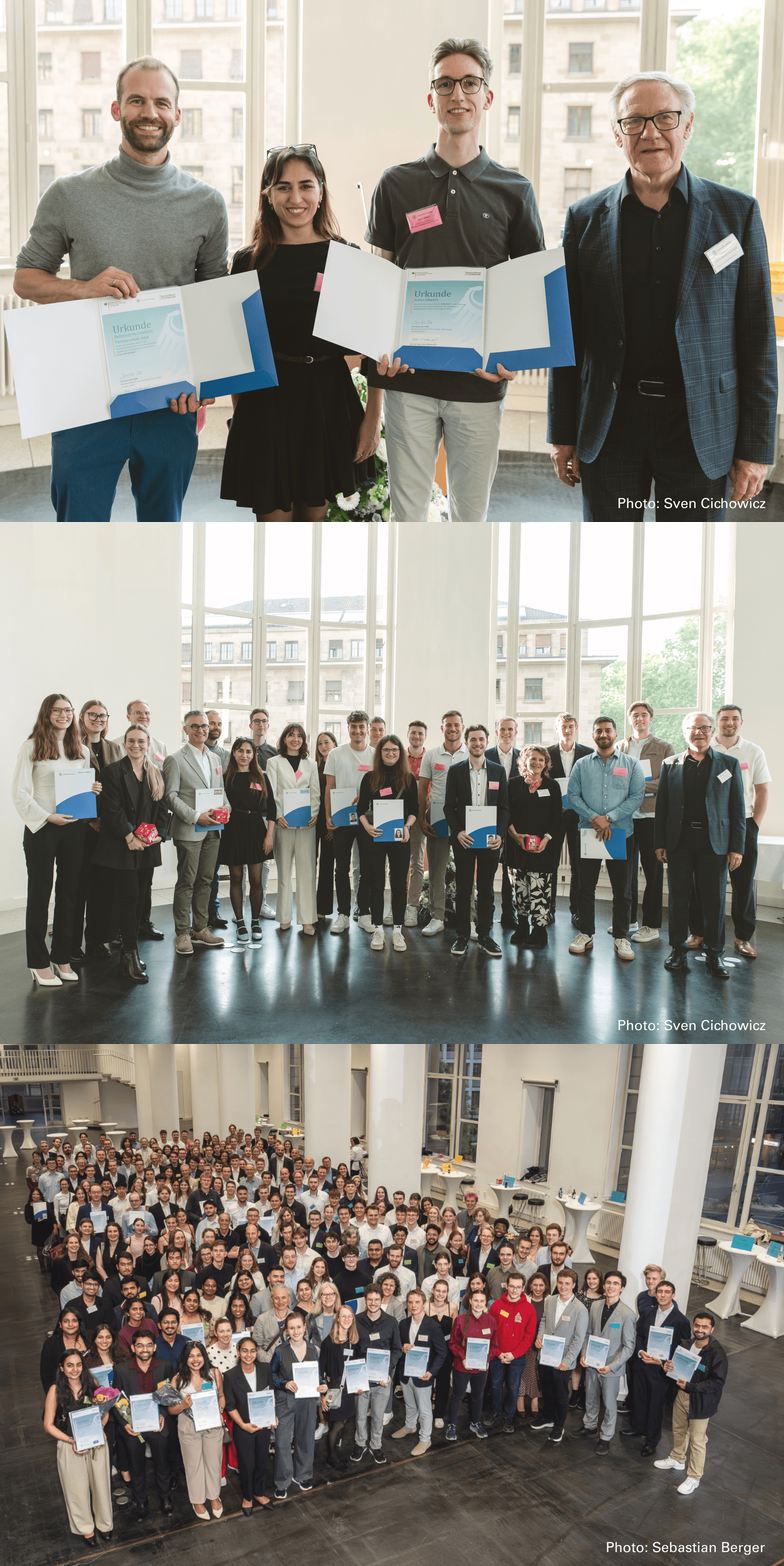
Partner Florian Waller knows the Deutschlandstipendium from both perspectives: as a former scholarship holder and now part of our annual support for the program. Together with our colleague Cigdem Gündogdu, he attended the recent ceremony. This year, the scholarship supports Julian, a fourth-semester Architecture and Urban Planning student. He had named BEHNISCH ARCHITEKTURBÜRO as his preferred sponsor during the application process. For architecture students, model making can involve considerable material costs. The scholarship therefore offers practical support for Julian’s studies and gives him additional scope to focus on his academic work. Students interested in applying can find further information here: Universität Stuttgart
Today, our Partner Angie Müller Puch is speaking at Frankfurt University of Applied Sciences as part of the Master's programme Resource Optimized Building.
In her lecture, "Happiness with Less," she explores how sustainable building can inspire creativity. Through a variety of project examples, from simple building approaches and material reuse to circular construction, she highlights different ways of building more resourcefully. Rather than promoting a single approach, she emphasizes that sustainable design is about finding the right solution for each project by carefully balancing its context, available resources, and unique challenges.
Many thanks to Professor Anja Willmann for the invitation. We look forward to sharing ideas and engaging with the next generation of architects.
Join us at Architektouren this Sunday, June 28, for guided tours through Sportpark Ost in the east of Regensburg. The ensemble of athletics hall and indoor pool forms a clear, welcoming civic place shaped by generous daylight, a legible structure, and barrier-free access. Sustainability is embedded from the ground up. Recycled concrete from the former barracks next door and load-bearing timber support a circular approach and future adaptability. Green facades and selected green roofs enhance the microclimate, while captured rainwater irrigates planting and sports turf. Efficient ventilation, natural night cooling in the athletics hall, and on-site renewable energy systems reduce operational demand and strengthen resilience.
The project received the Bavarian Chamber of Architects ’KlimaKulturKompetenz’ recognition for Energy Efficiency, Climate Adaptation, and Accessibility (2026).
As part of the Campus Steinfurt development for FH Münster, façade elements from a building currently being dismantled in Munich will be reused. The materials have been assessed and approved by experts for their further use. The reused trapezoidal metal sheets will form the façade of the new Building Q.
The concept extends beyond the building envelope. Offcuts from the façade will be integrated into the interior design of the foyer. They will be used for flexible furniture such as benches and stools, mobile planting systems, and wayfinding elements.
This approach demonstrates how circular construction can be implemented within a public building process, from dismantling and material preparation to reintegration in a new architectural context. A step towards reducing CO₂ emissions and rethinking the lifecycle of building materials.
Last weekend, we celebrated the reopening and extension of Buchheim Museum der Phantasie at Lake Starnberg, marking 25 years since the museum first opened in Günter Behnisch’s iconic building in 2001. The anniversary exhibitions reflect both the museum’s history and its future, including “Revolt of Colors. Karl Schmidt-Rottluff and the Legacy of Die Brücke,” on view until mid November. Visitors can also see the original architectural model from the 1990s together with a preview of the museum’s new extension.
While the full reopening is scheduled for the end of the year, selected parts of the museum are already accessible to visitors again during the ongoing refurbishment works. The refurbishment and extension continue the original vision of the museum while creating new spaces for exhibitions, education, and the “Labor der Phantasie.”
Thank you to everyone who joined us for the opening weekend and celebrated this new chapter of the museum with us.
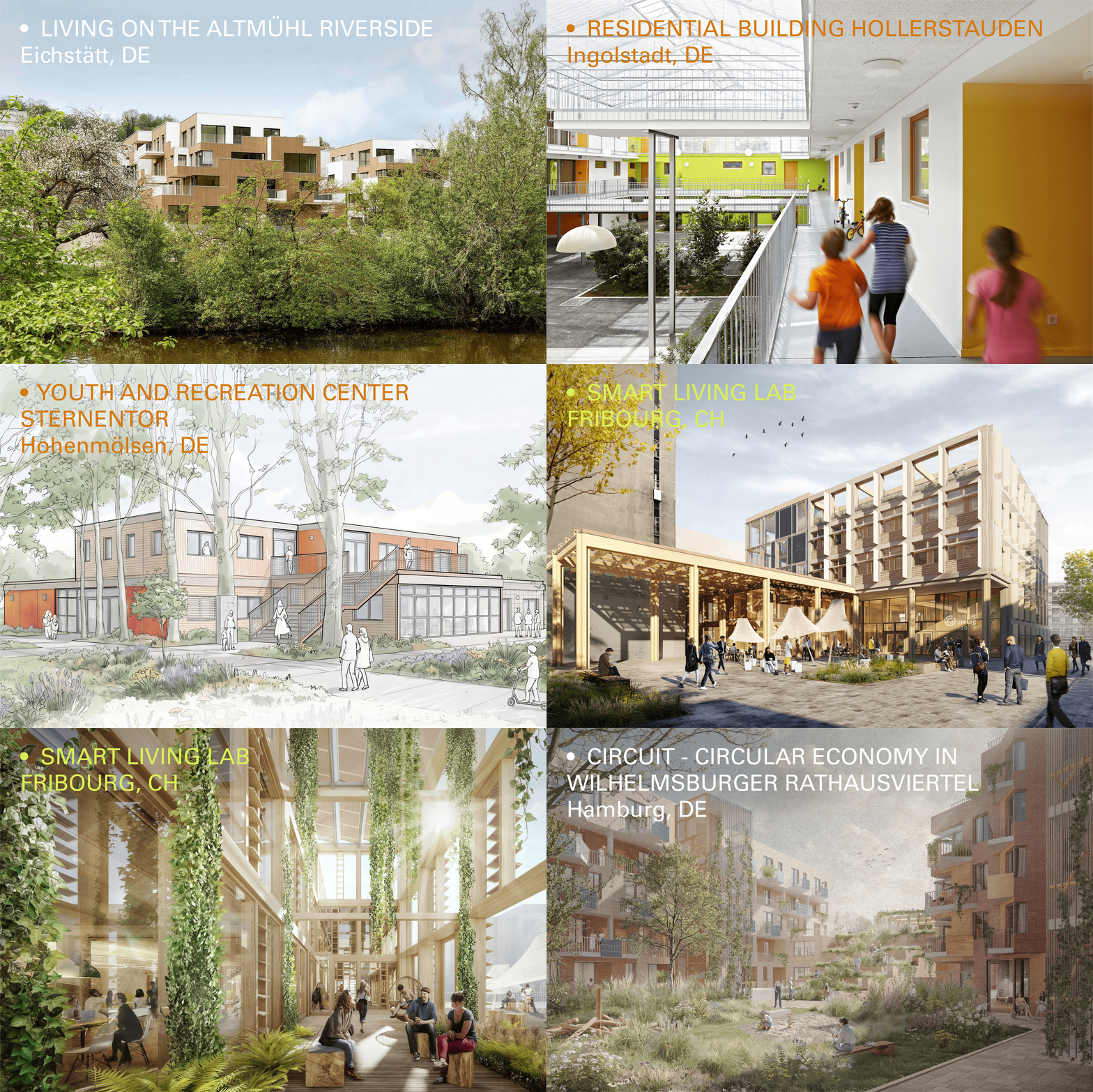
Can reclaimed materials shape the future of architecture? The Youth and Recreation Center Sternentor in Hohenmölsen offers a compelling answer. As a pilot project for circular construction, it demonstrates how existing resources can be transformed into meaningful, future oriented architecture. Developed within the EU research initiative RE:CREATE and initiated by the Chair of Circular Construction at BTU Cottbus Senftenberg in collaboration with the City of Hohenmölsen, the project reuses precast concrete elements from a former GDR era housing complex, giving them a new architectural life. Set on the site of a former outdoor swimming pool, the new center will become an open meeting place for all generations, combining indoor and outdoor activities within a distinctive natural landscape. By conserving embodied energy and reducing CO2 emissions by over 90 percent compared to conventional construction, Sternentor highlights the immense potential of reuse, bridging environmental responsibility with social impact and architectural quality.
With our new name Behnisch Architekturbüro and the launch of behnisch.com, we mark an important step in the ongoing development of our practice. Across our four locations, we are strengthening our identity as one office, presenting our work and approach in a more unified way. Both reflect a clearer identity and our continued commitment to sustainability, transparency, and sharing knowledge. The new website is conceived as an open and evolving platform that offers comprehensive access to how we work. It brings together our projects, people, processes, and research in a clear and intuitive structure, designed for both mobile and desktop use.
Sustainability is at the center of the platform. An expanded series of detailed case studies gives deeper insight into design strategies, environmental concepts, and the measurable impact of our projects. These are complemented by a resources section, which brings together research, publications, and insights developed within the office, alongside external sources that inform our work. The website is designed to reveal connections across projects and ideas. Through fluid navigation and closely linked content, users can move between projects, themes, and typologies, from cultural and educational buildings to workplaces and sports facilities. This allows ideas, collaborations, and developments to be understood across different scales.
Our approach to sustainability also extends into the digital experience. The website includes an energy saving mode that reduces data usage and energy consumption during browsing. behnisch.com is not a static portfolio but a working platform for clients, collaborators, researchers, and a wider public. It offers insight into the thinking behind our projects and creates space to explore the topics that continue to shape our practice. For more details, the full official statement is available here.
Architecture thrives on initiative. We are always interested in meeting people who bring their own perspective to the built environment. Whether you are at an early stage of your journey or already experienced, we welcome unsolicited applications that reflect your ideas, your process, and your ambitions.
Share your work and get in touch, regardless of current openings here.
Our proposal for the School Campus Hohewart² has received an honorable mention. The design builds on the site’s existing landscape character, preserving most of the valuable tree population while carefully integrating new buildings into the natural topography. Rather than a collection of isolated structures, the campus is envisioned as an ensemble of clearly defined volumes that together create a coherent, identity-shaping whole. At the heart of the campus is a vibrant, central space that fosters connection, community and exchange between the two schools. Differentiated outdoor areas, varied spatial sequences, and flexible learning clusters support contemporary educational concepts while maintaining the site’s intimate scale and grain.
Thank you to everyone who contributed to this project.
Throwback to the final guest critique at HEIA Fribourg, where our partner Angie Müller-Puch joined the studio module 'Atmosphères' exploring the revitalisation of a former industrial site called “La Pisciculture”. Students presented strong architectural concepts that reframe the existing structures through reuse, working with what is already there while using atmosphere as a design tool that connects space, emotion, program, and human interaction. With its large industrial halls set within the Sarine river landscape, the site offered a powerful setting to rethink transformation through a circular lens and reminded us that sustainable architecture often starts by preserving what is best, improving what exists, and introducing the new carefully with minimal change and maximum impact.






.gif)